
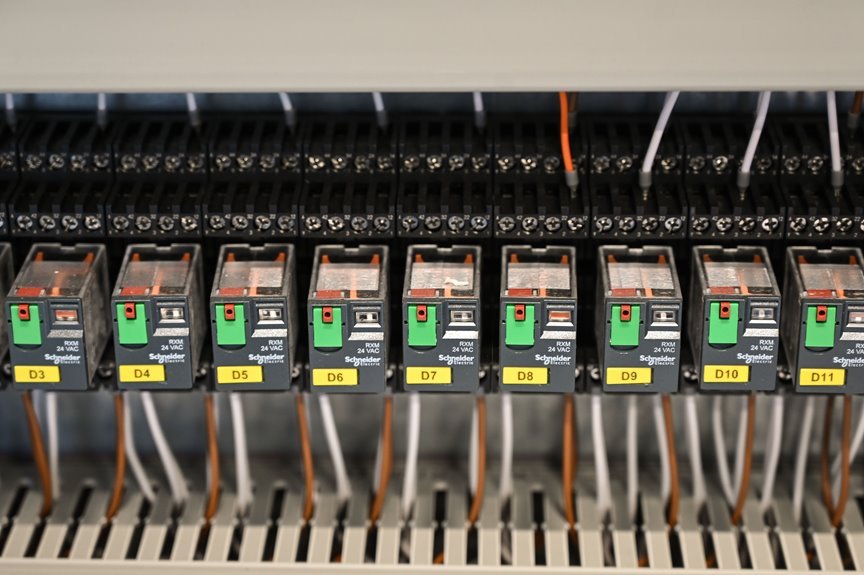
The AetherPulse Relay Matrix presents a five-node framework mapped to the identifiers 8582513828, 5167866943, 4702312109, 8779140059, and 6186227546. Each identifier anchors a discrete relay module within a layered topology designed for synchronized pulsing and modular coordination. The design emphasizes adaptive routing, fault resilience, and autonomous reconfiguration while maintaining secure boundaries. Its implications span multiple industries, offering scalable interfaces and transparent governance, yet questions remain about implementation thresholds and real-time constraints.
H2 #1: What Is the AetherPulse Relay Matrix? Foundations and Five-Node Mapping
The AetherPulse Relay Matrix is a conceptual framework that models how signals propagate through a structured network. It defines five nodes as functional anchors, enabling ethereal synchronization across layers and preserving modular topology. The model emphasizes deterministic pathways, clear interfacing, and scalable coordination. By design, it presents a minimal, interoperable map for resilient, freedom-centered communication architectures.
H2 #2: How the Five Identifiers Translate to Relay Modules and Topology
How do the five identifiers map onto relay modules and the overall topology within the AetherPulse framework? The identifiers align with discrete relay modules, defining input, process, and output stages. Interconnections form a layered topology that preserves modularity and extensibility.
Design Principles guide placement; Fault Resilience is built into redundancy and graceful degradation, ensuring reliable operation across dynamic conditions.
H2 #3: Architectural Principles: Synchronized Pulsing, Adaptive Routing, and Fault Resilience
Architectural Principles establish how synchronized pulsing, adaptive routing, and fault resilience cohere within the AetherPulse framework. The design provides conceptual scaffolding for network timing, dynamic path selection, and containment of disruption.
It identifies failure modes, clarifying boundaries between normal operation and fault conditions, while preserving agency for autonomous reconfiguration, resilience testing, and safe, uninterrupted data progression across the matrix.
H2 #4: Practical Implications Across Industries: Autonomous Systems, Immersive Media, and Real-Time Collaboration
Across autonomous systems, immersive media, and real-time collaboration, the AetherPulse framework translates synchronized pulsing and adaptive routing into tangible performance gains, resilience, and scalability.
It enables future proofing through modular updates, standardized interfaces, and proactive risk assessment.
Ethical governance ensures transparent decision-making, data integrity, and accountability while deploying cross-domain solutions that balance autonomy, creativity, and user trust.
Frequently Asked Questions
How Is Latency Measured in the Aetherpulse Network?
Latency is measured via end-to-end timestamps, processing delays, and inter-node ping metrics across network telemetry, accounting for failure modes, recovery timelines, and scalability, within a modular topology that respects five node constraint, security guarantees, and independent operation.
What Are Failure Modes and Recovery Timelines?
A single fuse failing is the anecdote: a lighthouse lamp dims, but the keeper adapts. Failure modes exist; recovery timelines vary. Module isolation and topology independence ensure resilience, with structured rollback and transparent recovery timelines guiding system continuity.
Can Modules Operate Independently Without the Full Topology?
Yes, modules can demonstrate independent operation within certain limits, though topology constraints may restrict full autonomy; overall system integrity depends on remaining interconnected, balancing autonomy with required communication, synchronization, and fault isolation across the relay matrix topology.
How Scalable Is the Five-Node Constraint in Practice?
Can five nodes scale effectively in practice? The system demonstrates proportional scalability benchmarks with modular growth, and fault isolation remains largely contained. This topology supports predictable performance, yet real-world limits emerge from interconnect latency and resource contention.
What Security Guarantees Exist for Inter-Node Communication?
Security guarantees exist for inter-node communication, incorporating strong inter node encryption, topology resilience, and fault tolerance; the design emphasizes verifiable integrity, confidentiality, and continuity, enabling autonomous operation while upholding freedom through robust, auditable security controls.
Conclusion
The AetherPulse Relay Matrix embodies a compact, five-node system where each identifier maps to a distinct relay module, forming a coherent, synchronized topology. With adaptive routing, fault resilience, and autonomous reconfiguration, it preserves secure boundaries and data integrity while enabling real-time coordination. Across industries, the framework supports scalable, interoperable interfaces for autonomous systems and immersive media. Its behavior resembles a finely tuned orchestra, where each instrument harmonizes to deliver predictable, resilient performance.
